Archive entry · NB-0011
The Cairo Sun
Nubian Beats
Cinematic · 4:08
2 plays
Description
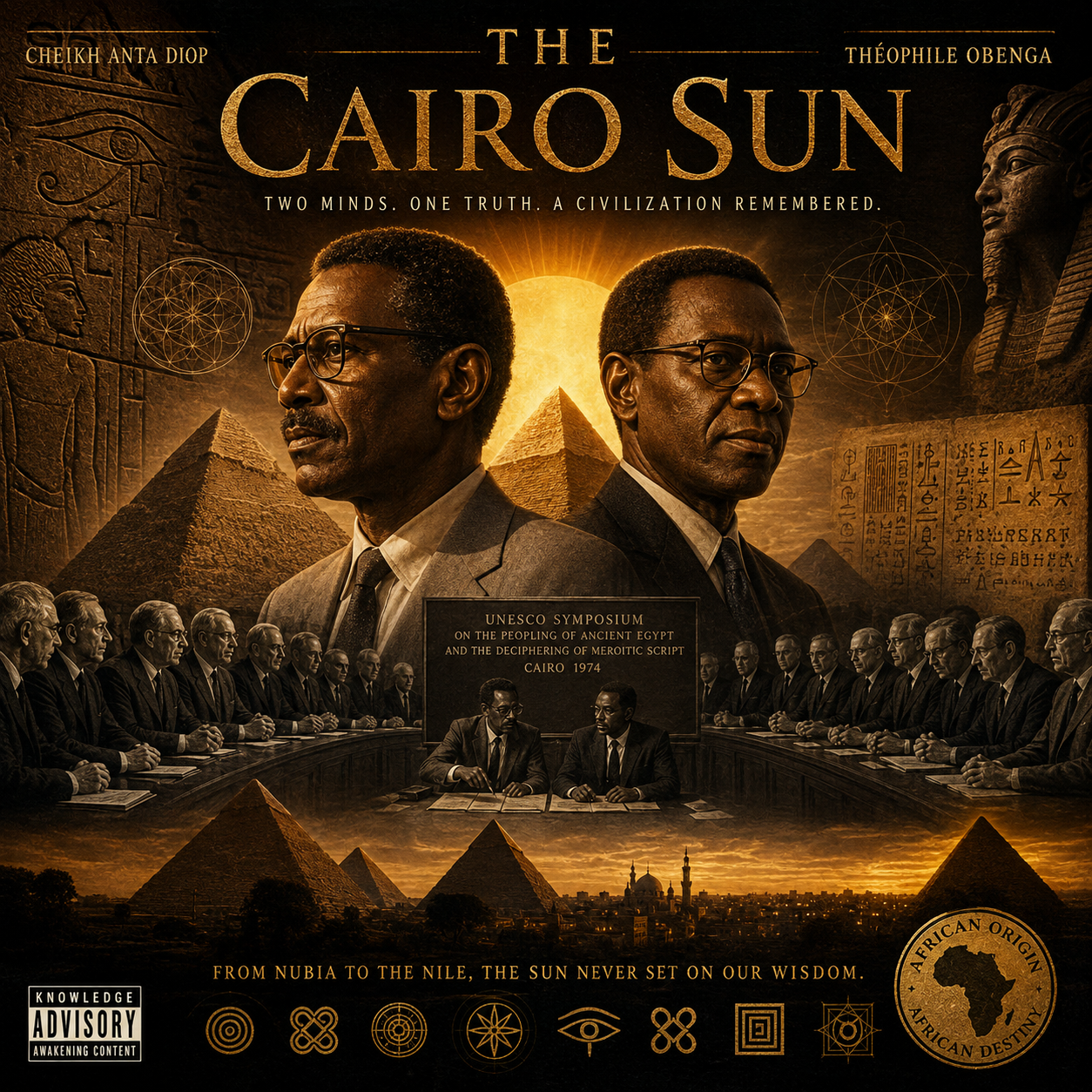
In 1974, scholars gathered in Cairo for UNESCO’s Symposium on the Peopling of Ancient Egypt and the Deciphering of Meroitic Script. Among them were Cheikh Anta Diop of Senegal and Théophile Obenga of Congo, two African intellectuals who arrived prepared to defend a proposition with enormous consequences: Ancient Egypt could not be understood by separating it from the African continent that produced it. The Cairo Sun imagines that encounter not as an ordinary academic conference, but as an intellectual battle. Diop and Obenga enter outnumbered, facing established scholars and deeply entrenched interpretations of Egyptian history. Their weapons are evidence: linguistics, anthropology, cultural comparison, historical sources and scientific argument. There are no cavalry charges, rifles or armies. Yet the stakes are civilizational—the right of a continent to interrogate the historical narratives that had been constructed around its own past. Bright brass announces their arrival. Kora roots the victory in Africa. Cello carries the gravity of centuries, while the choir transforms the confrontation into something larger than the two men themselves. French appears within the song as another echo of the intellectual world in which Diop and Obenga worked and argued. The song deliberately treats their courage as a form of heroism. The victory is not presented as the humiliation of other scholars, nor as the simplistic claim that every historical question was permanently settled in one room. It is the victory of African scholars entering one of the most consequential debates about African antiquity and insisting that Africa speak for itself—with scholarship rigorous enough to demand an answer. And that is why The Cairo Sun ultimately looks beyond 1974. Its real ending belongs to the generations that came afterward: an African child opening a book, looking upon Ancient Egypt without estrangement, and recognizing that the intellectual inheritance of Africa is something he is entitled not merely to admire, but to investigate, question, understand and continue. Two minds entered the room. A continent entered with them.